Member Benefits
Group Health Plan — Official FAQ
2027 rates, both medical plans, dental, vision and supplemental coverage, and everything you need for open enrollment, November 16–27. Including what we still don't know.
Everything below is detail. This is the assignment.
A group health plan sponsored by the National Association of State Farm Agents, built so independent State Farm agency owners and their teams can buy coverage together as one large group. Coverage starts January 1, 2027.
Brown & Brown is the broker that built and filed it, and Blue Cross Blue Shield of Illinois is the carrier that insures it. There are two medical plans, a PPO and an HSA-eligible high-deductible plan, both on Blue Cross's broad PPO network. Optional dental, vision and supplemental coverage are available alongside them.
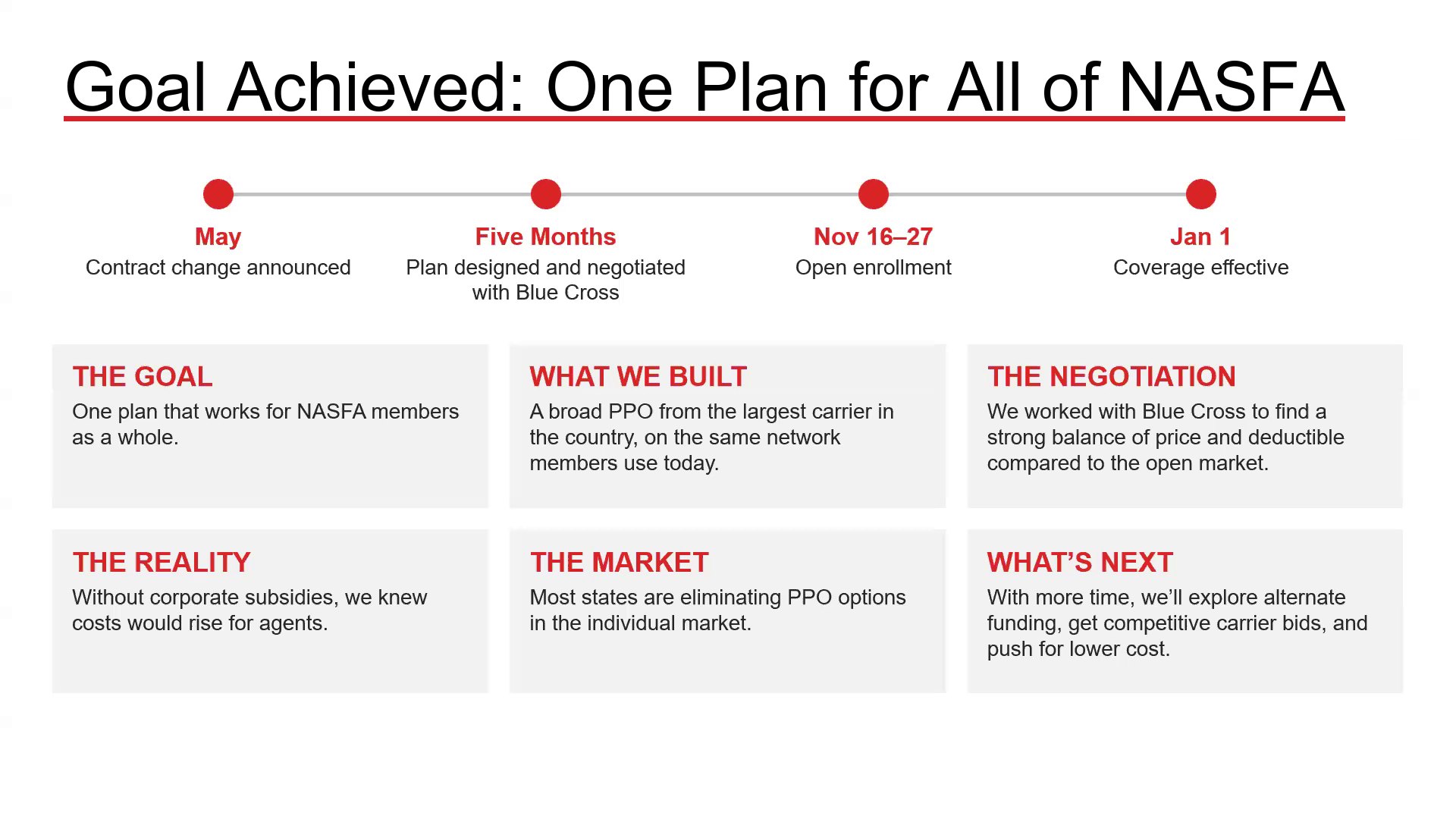
Here is the paper trail:
| Date | Milestone |
|---|---|
| July 2026 | Brown & Brown selected as broker |
| August 10 | MEWA/AHP filed with the Illinois Department of Insurance |
| August 11 | MEWA presented to Blue Cross Blue Shield of Illinois |
| August 17 | MEWA approved |
| October 20 | 2027 rates and plan designs released |
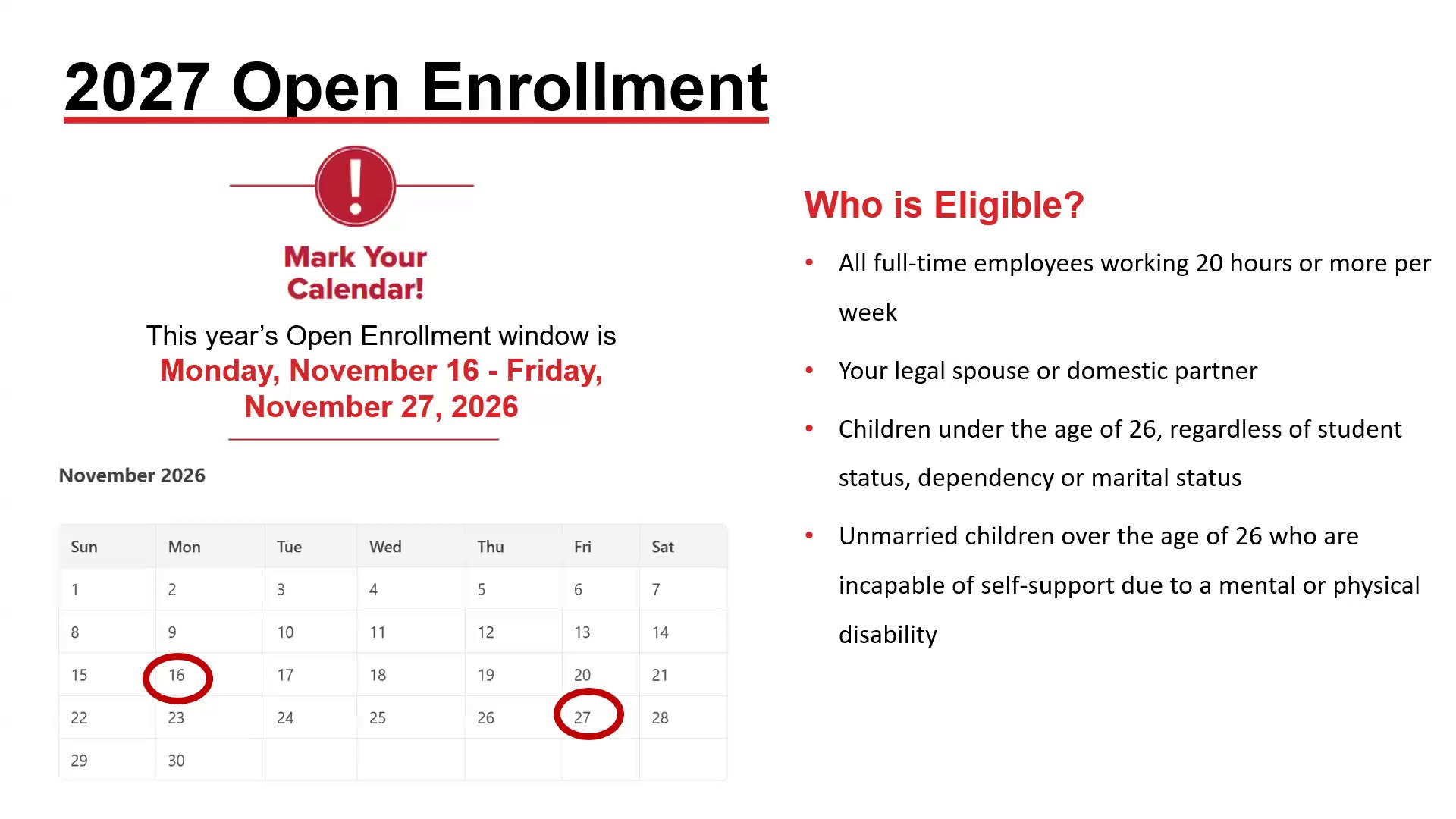
| November 16–27 | Open enrollment |
| January 1, 2027 | Coverage begins |
This is no longer a proposal. It is an approved, priced plan heading into enrollment, put together in about five months.
It's a legal structure that lets many separate small employers — independent agency owners in the same profession — buy health coverage as one large group instead of as thousands of tiny ones.
Large groups get large-group pricing, large-group underwriting rules, and plan designs that no single agency could access alone. That's the entire thesis: scale buys leverage.
The "E" in MEWA stands for employer. That one word explains several of the eligibility rules below, including why retired agents can't join.
These are the full monthly premiums for 2027 medical and prescription coverage:
| Coverage tier | PPO | HDHP (HSA-eligible) |
|---|---|---|
| Employee only | $796.80 | $846.94 |
| Employee + spouse | $1,523.88 | $1,620.81 |
| Employee + child(ren) | $1,463.09 | $1,556.11 |
| Employee + family | $2,254.08 | $2,398.00 |
"Employee" means whoever is enrolling, whether that's you as the agent or a team member. Employee + family covers the employee, their spouse and their children. Dental, vision and supplemental coverage are optional and priced separately (see below).
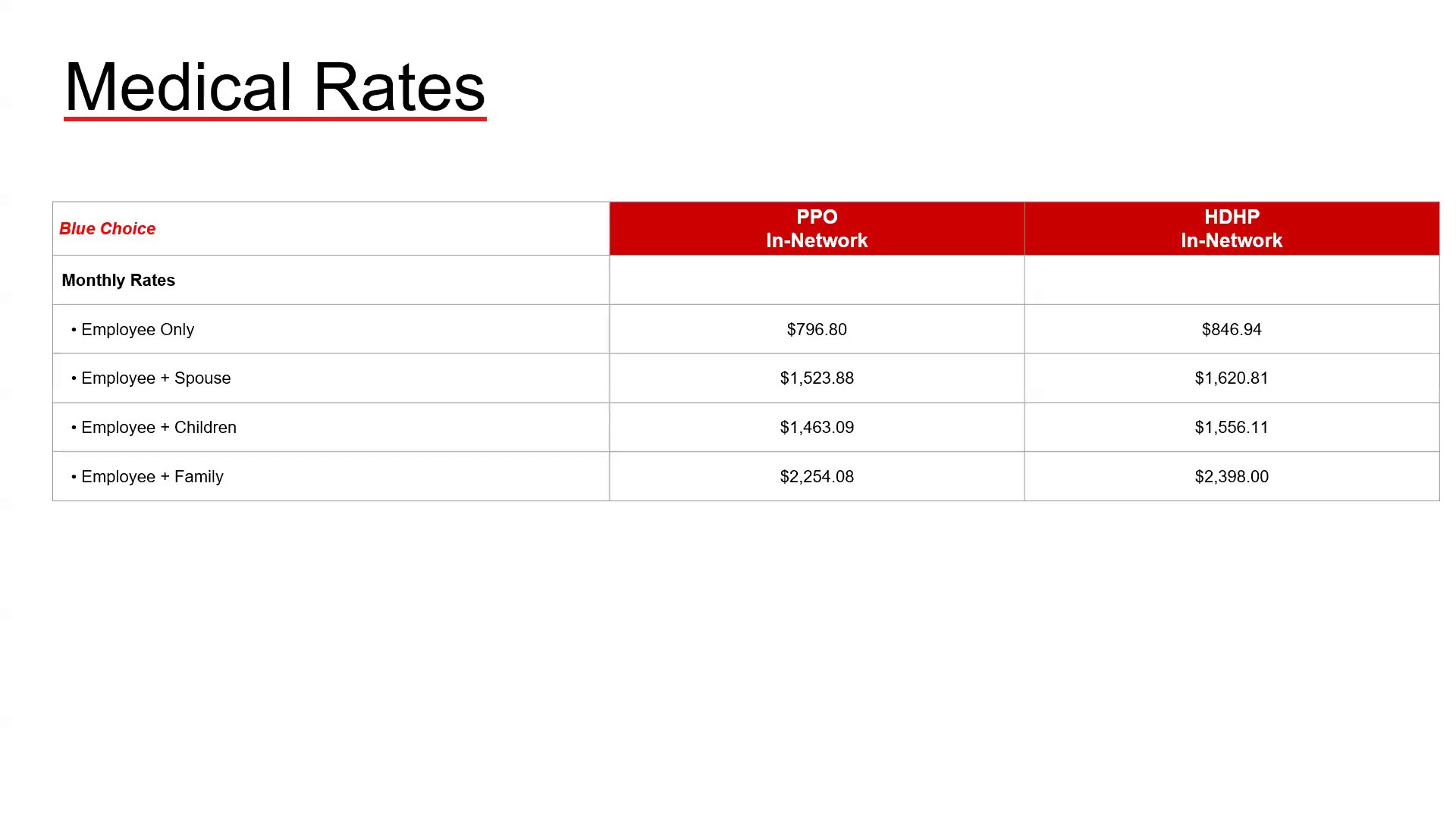
The medical rates are the same regardless of age and regardless of state. A team member enrolling in employee-only coverage on the HDHP pays $846.94 a month whether they're 25 or 60, in Texas or Michigan.
The number of children doesn't change the price either. "Employee + child(ren)" and "Employee + family" cover all of your children.
The one exception on this page is critical illness insurance, an optional add-on whose rates are based on age.
Because in this case the HDHP is the richer plan. It has the lower deductible ($5,000 vs. $7,000 per person), the lower out-of-pocket maximum, and pays 80% after the deductible instead of 70%. A richer benefit means a higher premium.
The names are confusing. Both plans use the same broad PPO network. "HDHP" here just means the plan is built to qualify for a Health Savings Account (HSA). The plan labeled "PPO" is the one that does not qualify for an HSA.
Because the State Farm plan was subsidized and this one isn't. On the corporate plan, State Farm paid a large share of every premium. For a family, that was roughly $2,000 of a roughly $3,000 monthly cost. The paycheck deduction you saw was only your share.
That subsidy ends January 1. The rates above are the full cost of the coverage. If you've ever been on COBRA, you've seen the same jump: it's what the coverage actually costs once no one else is paying part of it.
Normally, if enrollment differs from the census by more than about 10%, the carrier can re-rate the plan. Brown & Brown got that provision removed. Whether 1,000 or 10,000 people enroll, these are the 2027 rates. There will be no mid-year increase.
Brown & Brown also got Blue Cross to waive its usual rule that employers pay at least 50% of each employee's premium. That's why you get to choose your own contribution, from 0% to 100%.
For most agents, the NASFA plan comes in below the individual market, and the gap widens with age. Brown & Brown compared the NASFA HDHP against HSA-eligible plans in several states, using sample households:
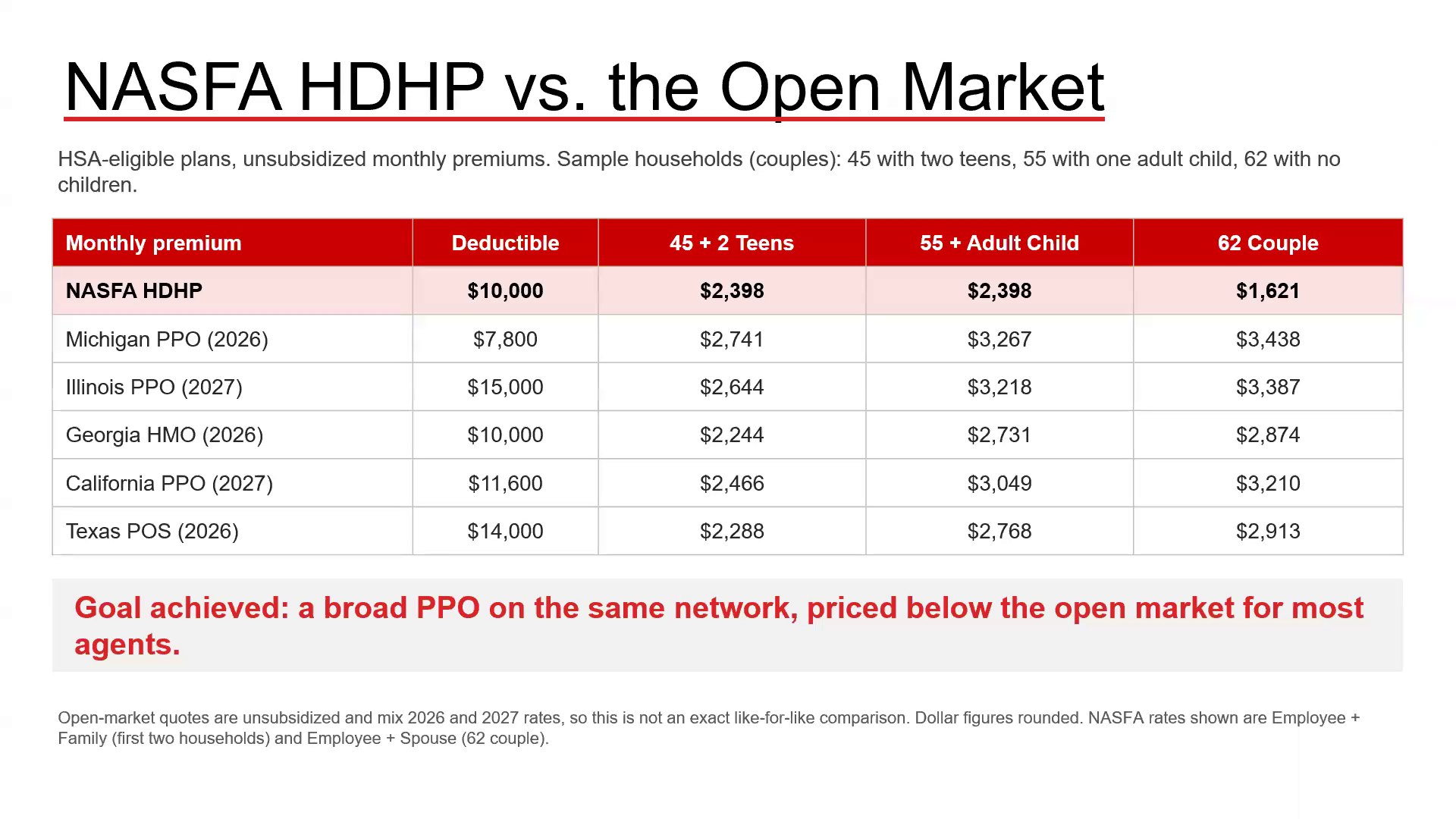
Two things to keep in mind as you shop. Most 2027 individual-market prices come out November 1, and many will be higher than the 2026 numbers above. And many states no longer offer PPO plans in the individual market at all, only narrower HMO networks that keep you in-state.
If you or a team member qualifies for income-based marketplace subsidies, the comparison is different. See the marketplace question under Who Is Eligible.
That's the goal, and here's why it's realistic. The plan was built in about five months, which left no time to get competing carrier bids or explore alternative funding. Blue Cross also priced in a cushion because it had no claims history for this group, and because it couldn't predict how many younger team members would join.
After a year, everyone will have real data. That opens the door to competitive bids, better pricing, and possibly more plan options, such as a lower-deductible plan.
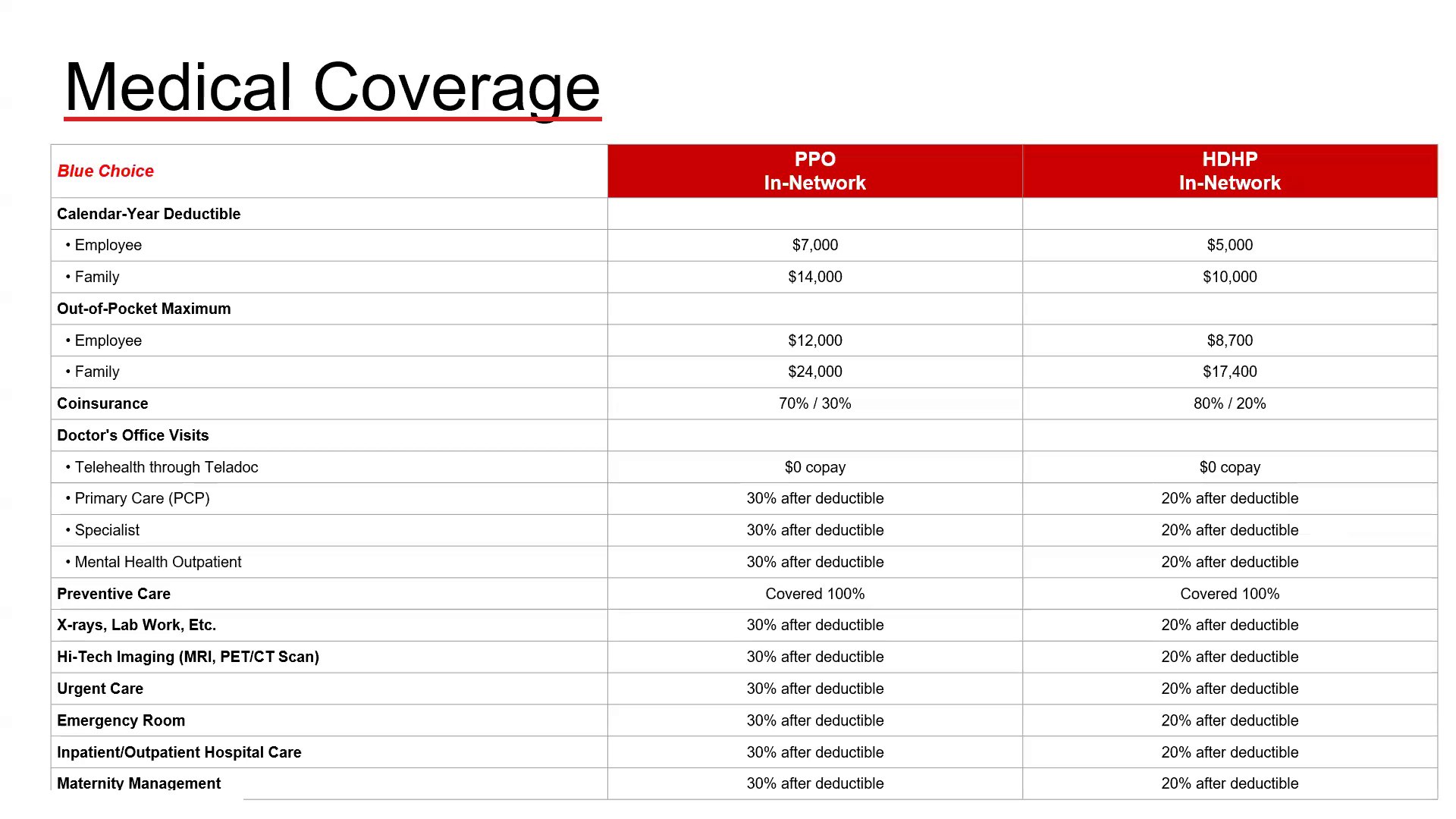
| In-network | PPO | HDHP (HSA-eligible) |
|---|---|---|
| Deductible (employee / family) | $7,000 / $14,000 | $5,000 / $10,000 |
| Out-of-pocket max (employee / family) | $12,000 / $24,000 | $8,700 / $17,400 |
| Coinsurance (plan / you) | 70% / 30% | 80% / 20% |
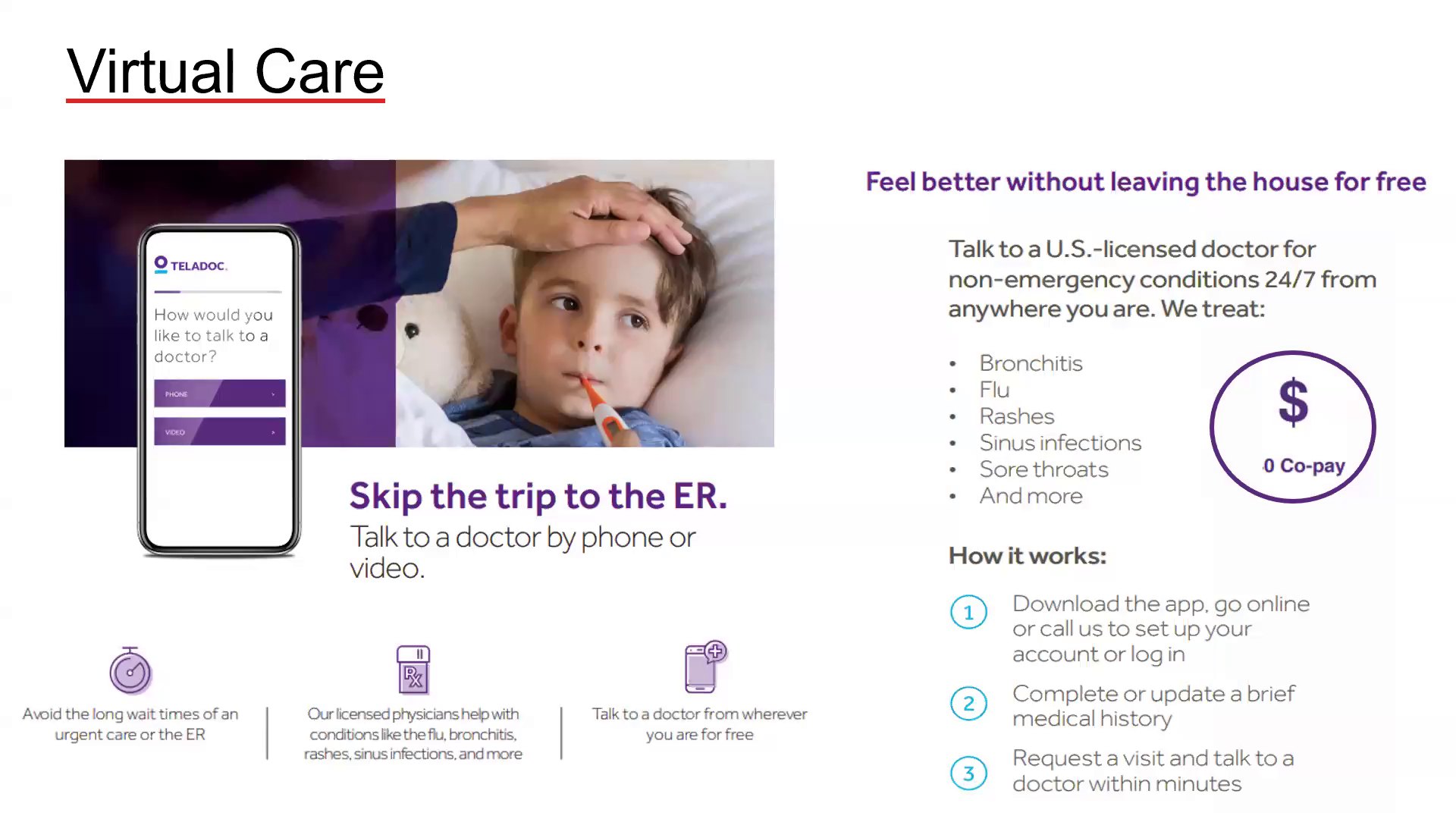
| Telehealth through Teladoc | $0 | $0 |
| Preventive care | Covered 100% | Covered 100% |
| Office visits, urgent care, ER, labs, imaging, hospital, maternity | 30% after deductible | 20% after deductible |
| Works with an HSA | No | Yes |
That's your call, but Brown & Brown's recommendation for most agents is the HDHP. For about $50 to $144 more a month, depending on the tier, you get:
The PPO exists to give a lower-premium option. For most households, the premium savings don't make up for the higher deductible and the loss of the HSA.
Both plans use Blue Cross Blue Shield of Illinois's broad, nationwide PPO network. The current State Farm plan is also insured by Blue Cross Blue Shield of Illinois. Brown & Brown confirmed it is the same network agents are using today.
What changes is the cost structure (deductibles, coinsurance and premiums), not where you can go for care.
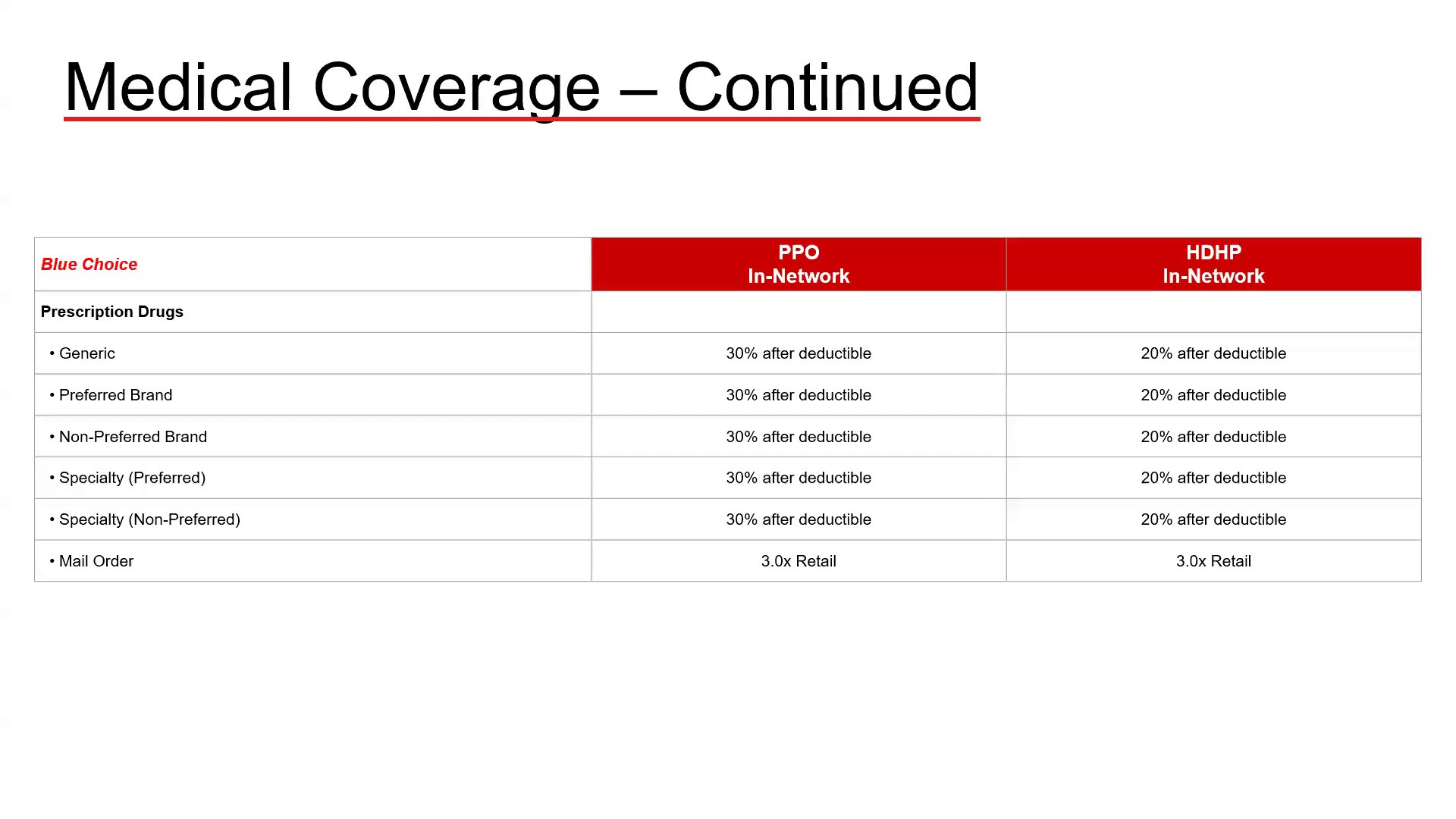
The plan uses the same drug list (formulary) as the current Blue Cross plan, so drugs covered today are covered on this plan. What you pay for them will be different:
Because prescriptions are subject to the deductible, generics matter more than they used to. If you take an expensive medication, use the enrollment call center to talk through your situation before you choose a plan (see Open Enrollment).
The plan is fully insured — it is not self-funded. Because of that, the carrier carries the claims risk — not NASFA, and not you as an individual agency owner.
The plan is ACA compliant. There are no medical questions and no pre-existing condition exclusions. Your health history, or a team member's, does not affect eligibility or price.
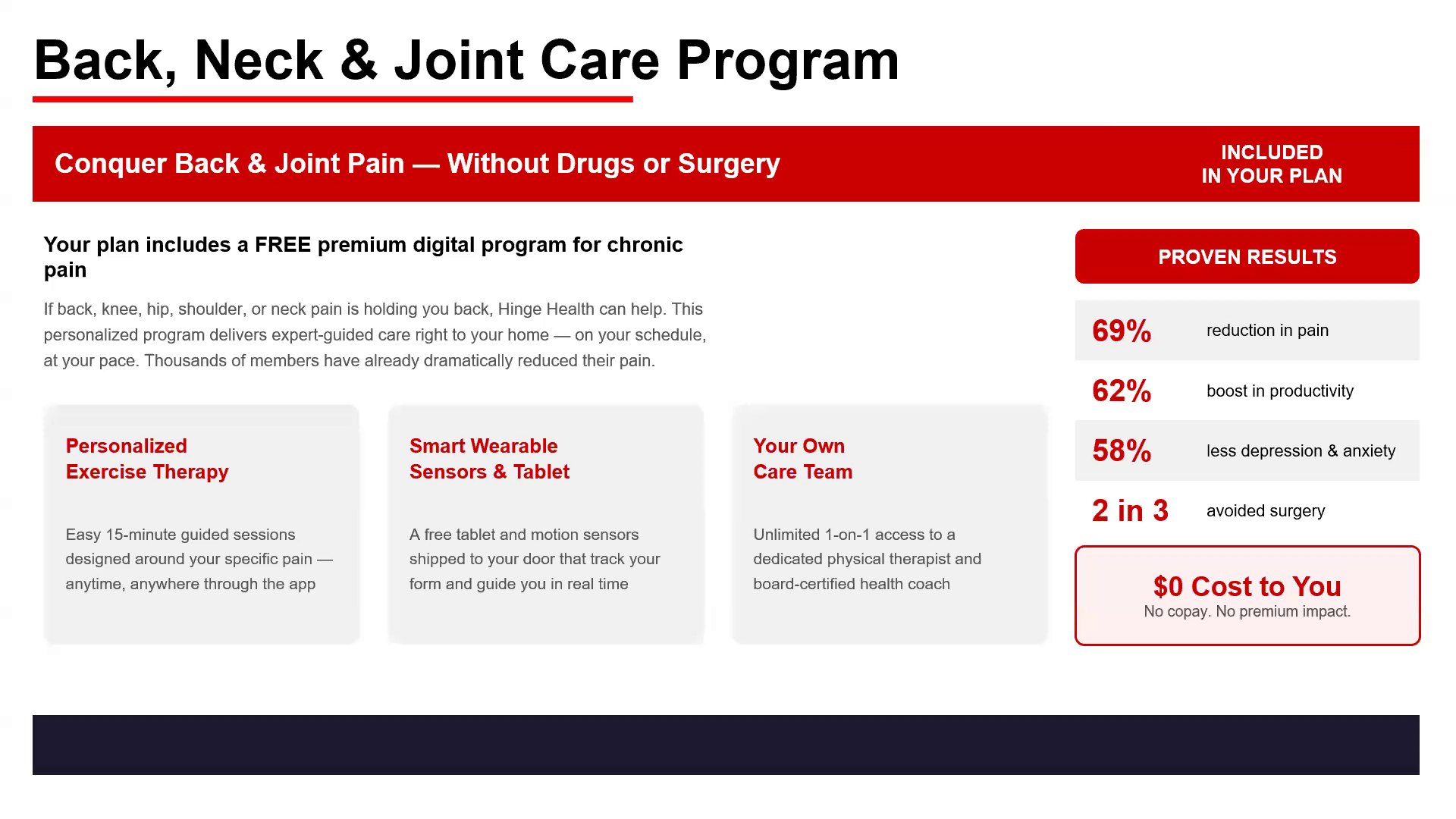
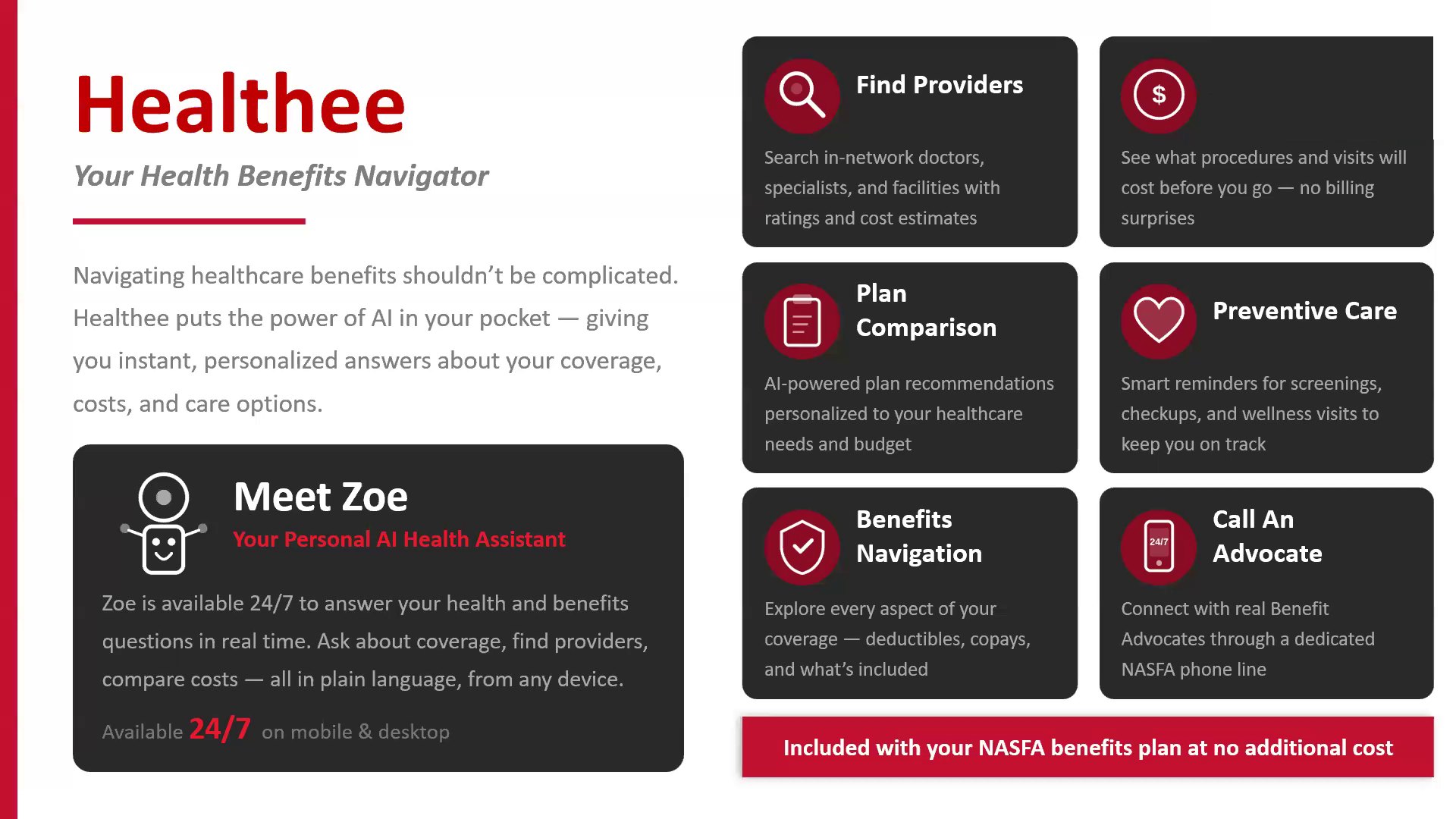
Four programs come with both medical plans at $0:

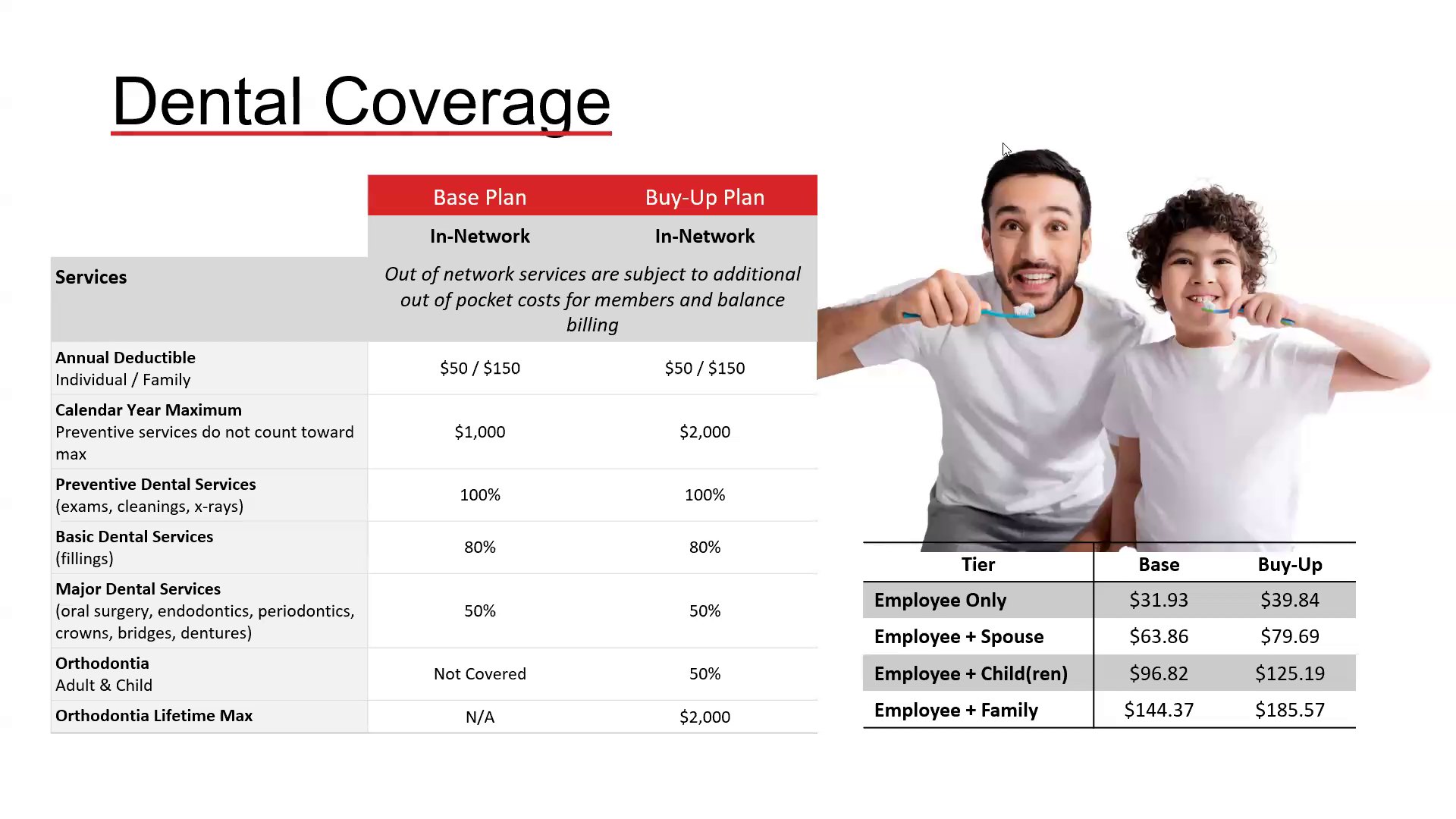
Both dental plans use Blue Cross's PPO dental network. The buy-up plan doubles the annual maximum and adds orthodontia.
| In-network | Base | Buy-up |
|---|---|---|
| Deductible (individual / family) | $50 / $150 | $50 / $150 |
| Annual maximum per person | $1,000 | $2,000 |
| Preventive (exams, cleanings, x-rays) | 100% | 100% |
| Basic (fillings) | 80% | 80% |
| Major (crowns, bridges, oral surgery, etc.) | 50% | 50% |
| Orthodontia (adult & child) | Not covered | 50%, $2,000 lifetime max |
| Monthly rate | Base | Buy-up |
|---|---|---|
| Employee only | $31.93 | $39.84 |
| Employee + spouse | $63.86 | $79.69 |
| Employee + child(ren) | $96.82 | $125.19 |
| Employee + family | $144.37 | $185.57 |
Preventive services don't count toward the annual maximum. Out-of-network dentists can bill you more.
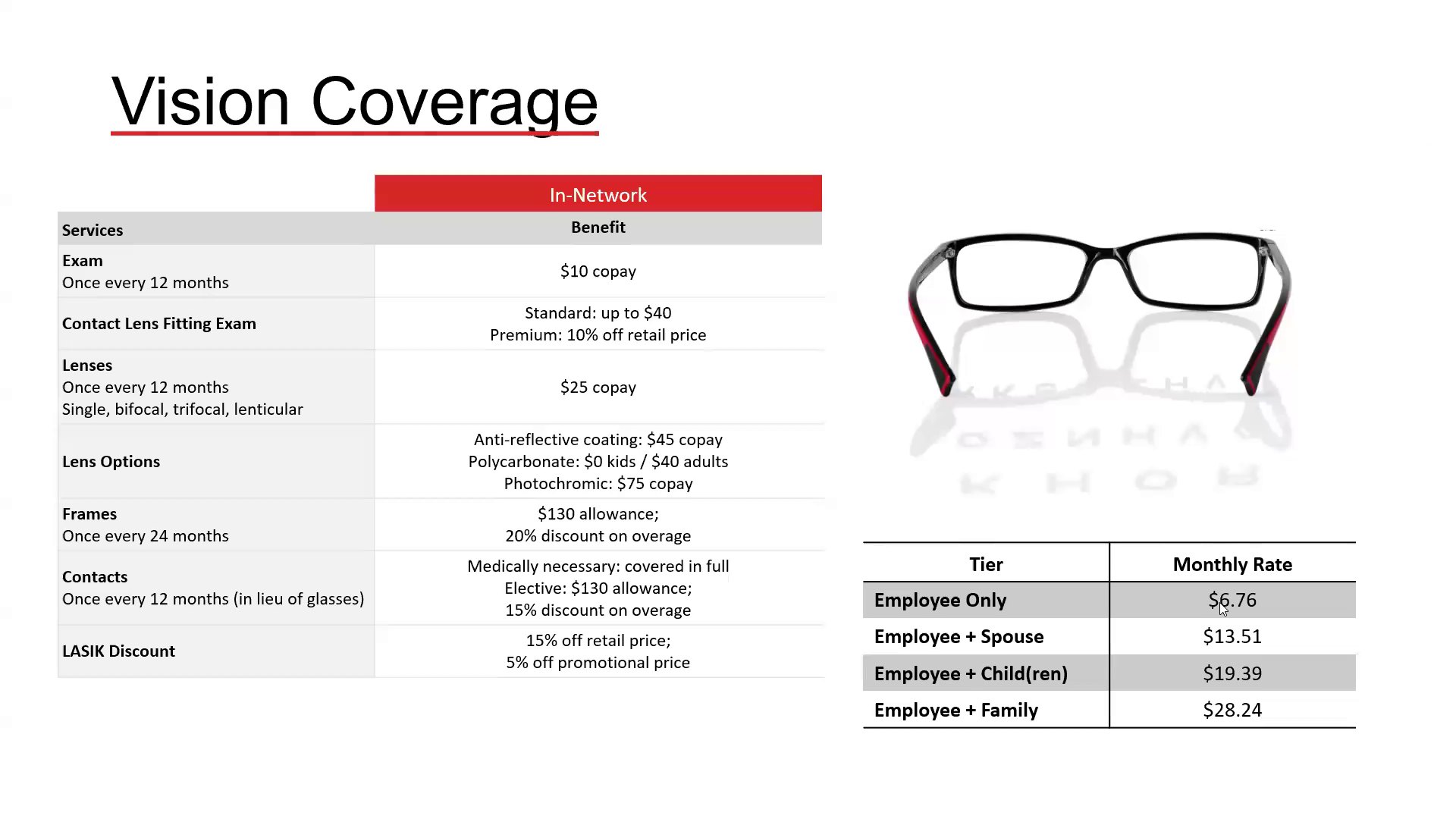
| Monthly rate | Vision |
|---|---|
| Employee only | $6.76 |
| Employee + spouse | $13.51 |
| Employee + child(ren) | $19.39 |
| Employee + family | $28.24 |
Three optional plans help cover the gaps a higher deductible can leave. Agents and team members can each choose them:
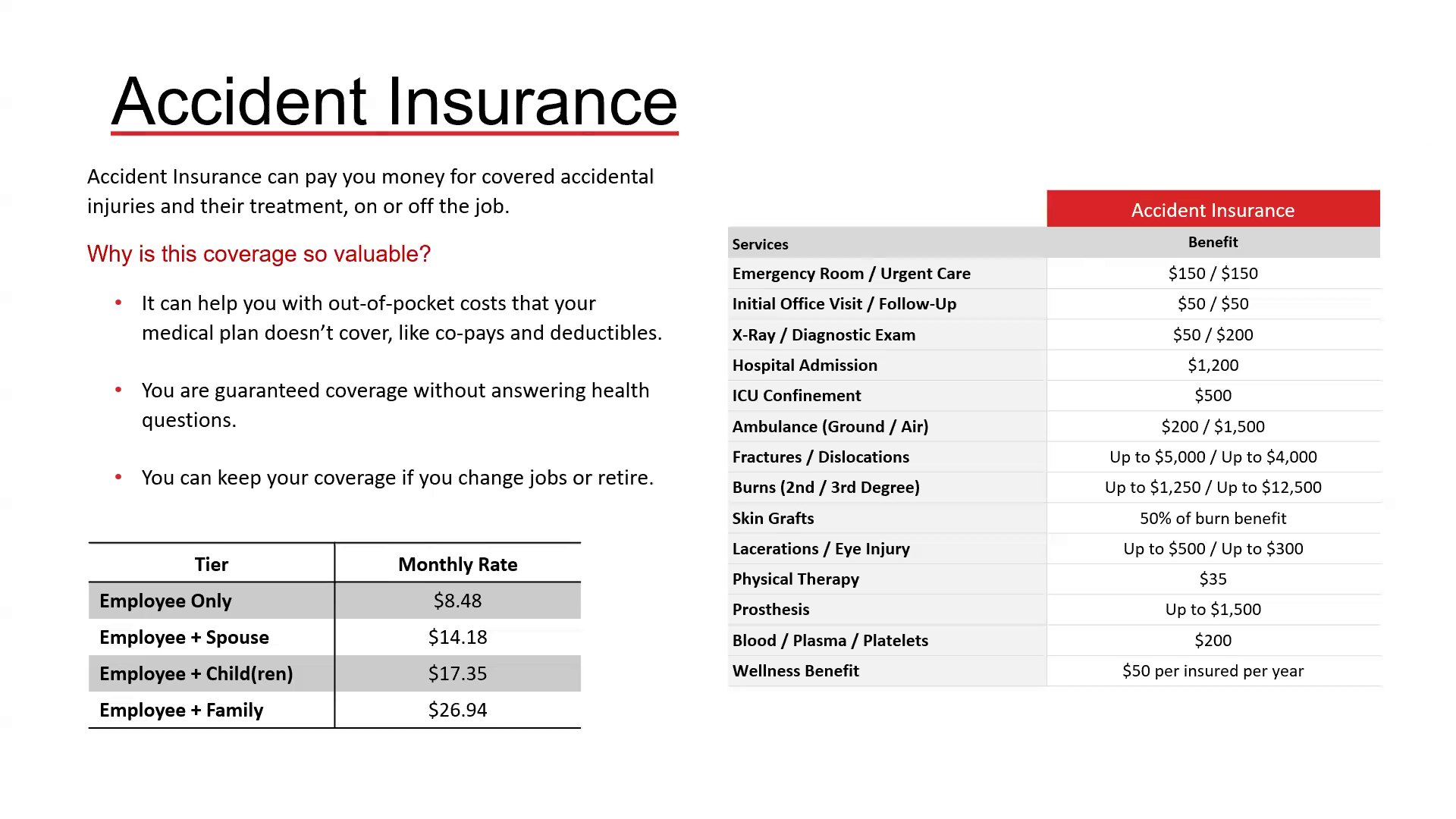
Pays you cash for covered injuries and their treatment, on or off the job: ER and urgent care visits, fractures, burns, ambulance, hospital admission and more. Guaranteed coverage, no health questions, and you can keep it if you change jobs or retire. Monthly: $8.48 employee · $14.18 + spouse · $17.35 + child(ren) · $26.94 family.
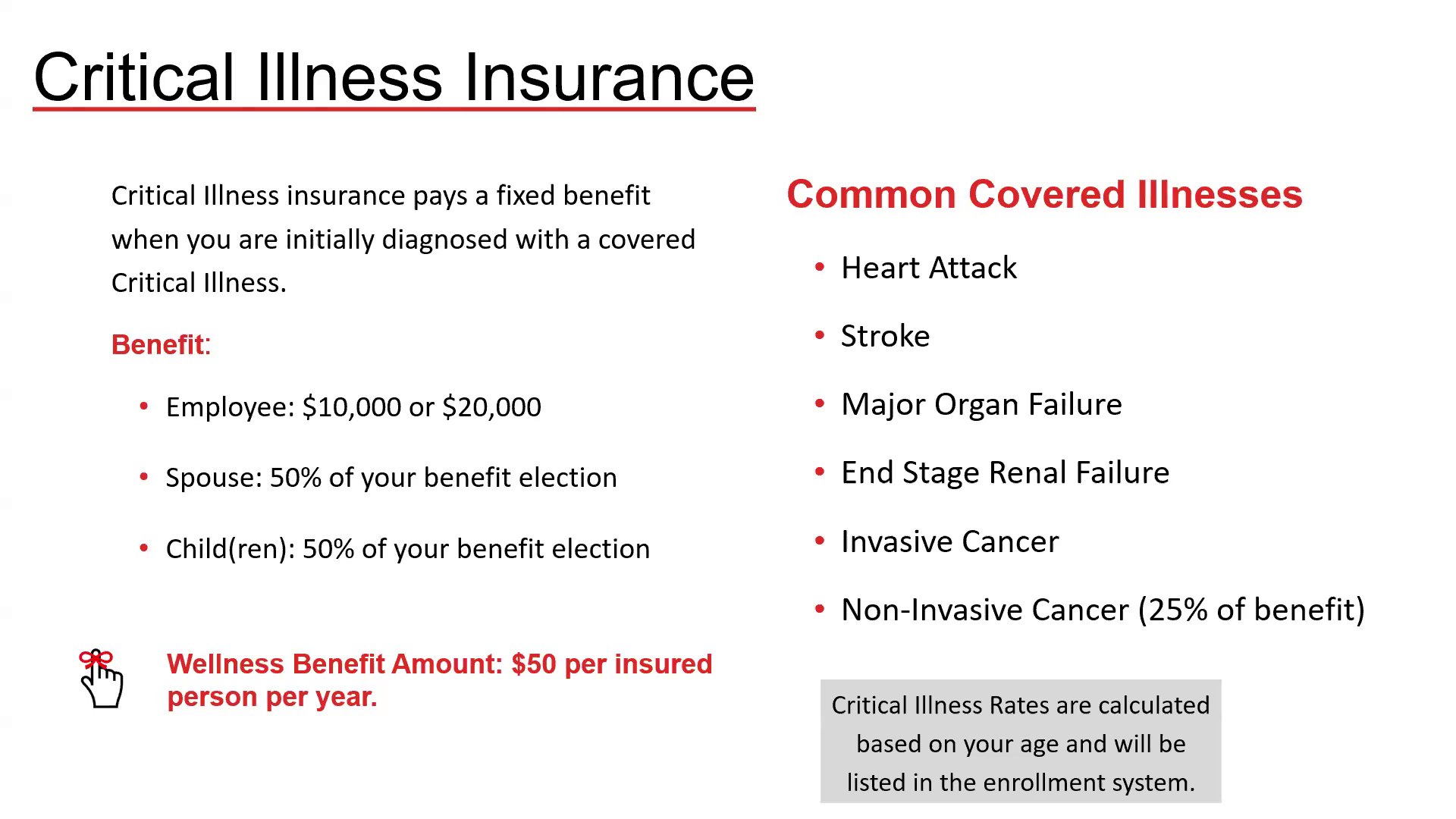
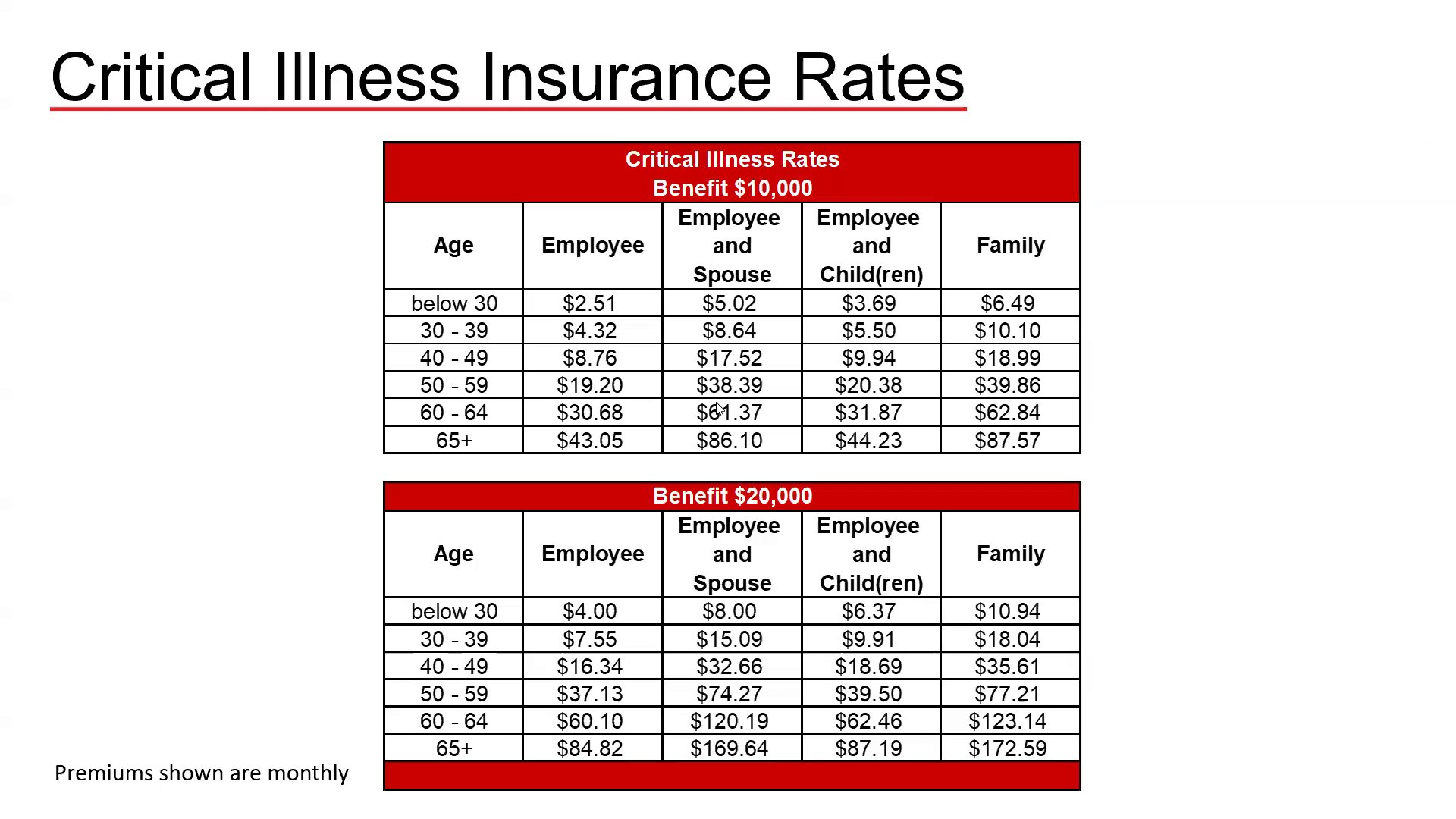
Pays a lump sum when you're first diagnosed with a covered illness, such as heart attack, stroke, major organ failure, end-stage renal failure or invasive cancer (non-invasive cancer pays 25%). Choose $10,000 or $20,000 for yourself. A spouse or children are covered at 50% of your amount. Includes a $50 per person yearly wellness benefit. Rates are based on age (see the rate slide below).
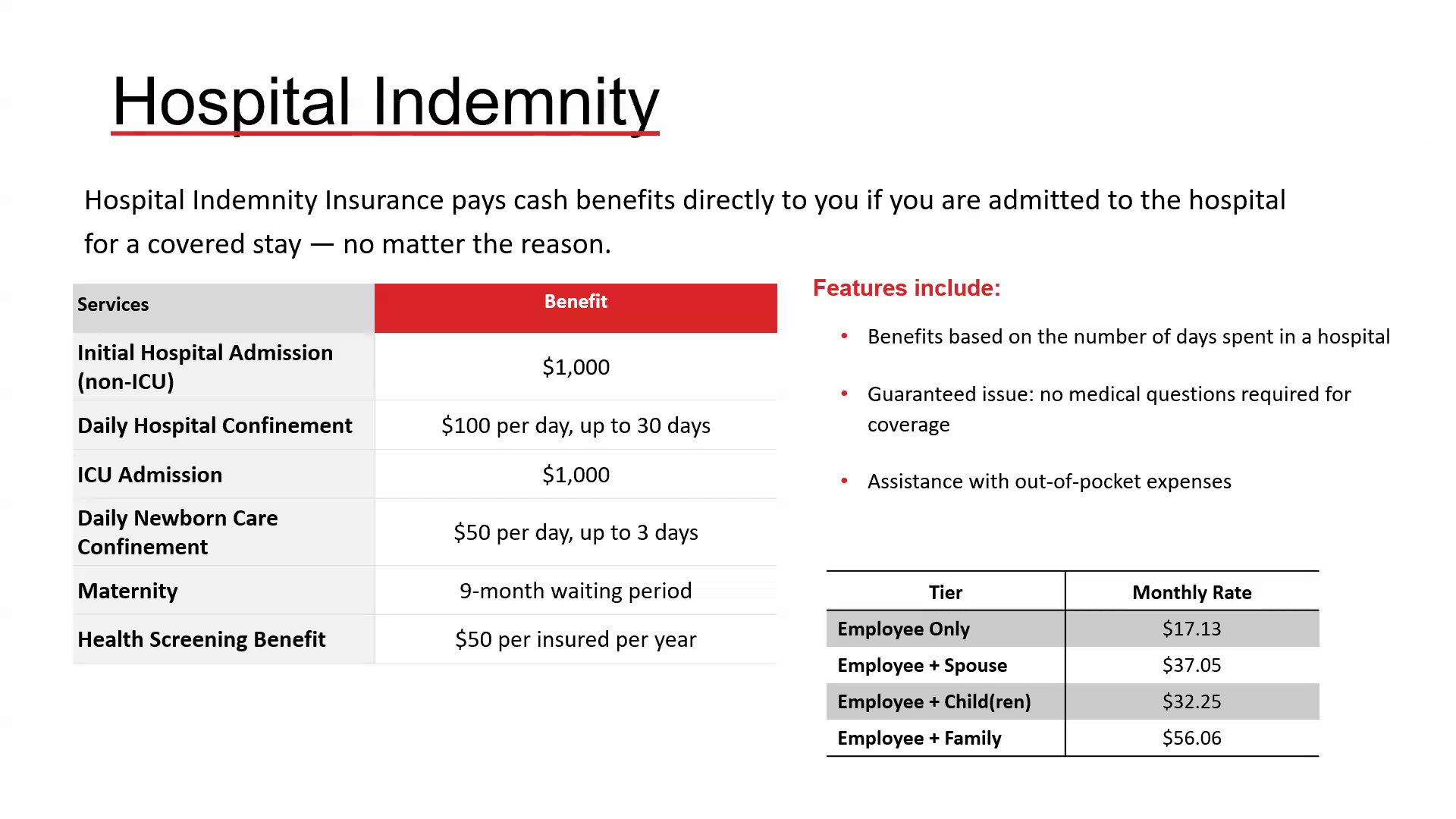
Pays cash directly to you when you're admitted to the hospital, for any covered reason: $1,000 for an admission, $100 a day up to 30 days, $1,000 for ICU admission, plus a newborn care benefit. Guaranteed issue, no medical questions. Maternity has a 9-month waiting period. Monthly: $17.13 employee · $37.05 + spouse · $32.25 + child(ren) · $56.06 family.
You can buy the dental, vision, accident, critical illness and hospital indemnity coverage even if you don't enroll in the medical plan. The same goes for your team members.
Once an employee (or you) enrolls, these family members can be covered:
Offering the plan and paying for it are two different things. You have to make the plan available to every employee who works 20 or more hours a week. You do not have to pay any part of their premium.
Blue Cross normally requires employers to pay at least 50%. That requirement was waived for this plan, so the choice is yours:
Whatever you choose, apply it the same way across your team. You can't pick and choose which team members get a contribution.
Every employee working 20 or more hours a week must be offered the plan. That threshold is lower than the 30 hours many agents are used to, so check your roster.
Offering is the requirement. Not enrolling, and not paying. If a team member has coverage through a spouse, or simply doesn't want it, they can decline. If no one on your team enrolls, that's fine.
Your team members can enroll even if you don't take the coverage yourself. For example, you might be on Medicare or on a spouse's plan. And you can enroll even if no one on your team does.
Not in most cases. It comes down to the ACA's affordability rules. If the plan isn't "affordable" for a team member under those rules (based on what they would pay for it compared with their household income), they can keep buying marketplace coverage and may still qualify for a subsidy based on their income.
The more you contribute, the more likely the plan counts as affordable. Once it does, that team member may no longer qualify for a marketplace subsidy. If this applies to your team, have them check their own numbers before you set your contribution.
A sole proprietor with no employees can't join the plan. Your agency needs at least one W-2 employee, because that's what makes it an "employer group" under the MEWA.
We know this affects agents who are between hires or intentionally running lean. If you're actively hiring, fill the position and you can join.
Any active agent can join, at any age, whether 65, 70 or 80. You don't have to go on Medicare if you don't want to.
Because this counts as active employer coverage, you won't be penalized for delaying Medicare. When you're ready to switch, there are a couple of forms to complete. One is normally filled out by the employer, and since you're the business owner, you'll complete it yourself. That keeps you clear of Part B late-enrollment penalties.
Medicare timing is personal. If you're weighing Part B against this plan, talk it through with the enrollment call center or a Medicare advisor before you decide.
If you're an active agent on Medicare, your spouse can join the plan even if they don't work in your agency.
Your spouse enrolls as a single, at the employee-only rate: $796.80 a month on the PPO or $846.94 on the HDHP.
You must be an active agent, or an employee of one, to be on the plan. This isn't a choice NASFA, Brown & Brown or Blue Cross made. It's a federal legal requirement. A MEWA is a multiple employer arrangement, and once you retire, you're no longer an employer, so you can't be part of the group.
The one path we know of: a retired agent who becomes a W-2 employee of an active agent, working 20+ hours a week, is eligible as that agency's employee.
You can enroll for 2027 as long as you're an active agent during open enrollment. Your coverage on the plan ends when you retire.
Whether continuation coverage (such as COBRA) will be available after that is being confirmed. Note that the optional accident insurance is portable: you can keep it after you retire.
NASFA membership is required to enroll. Regular membership is currently $350 a year, paid annually by credit card.
Don't wait for the enrollment window. Thousands of agents joining at once has overwhelmed the sign-up site before. Joining now means one less thing to do between November 16 and 27.
Membership matters structurally: the plan exists because NASFA is a long-standing bona fide association. That status is the legal foundation of the whole arrangement. Membership is held by the agent; team members and spouses enrolling under your agency don't need memberships of their own.
Join NASFA nasfa.com/Join-usMonday, November 16 through Friday, November 27, 2026. Coverage starts January 1, 2027.
The census was used to build and price the plan. It is not a requirement to enroll. Anyone eligible can enroll between November 16 and 27, whether or not they completed it. There's no need to fill it out now.
As long as you still have an active agency and you're a NASFA member, you can join the plan during the next open enrollment.
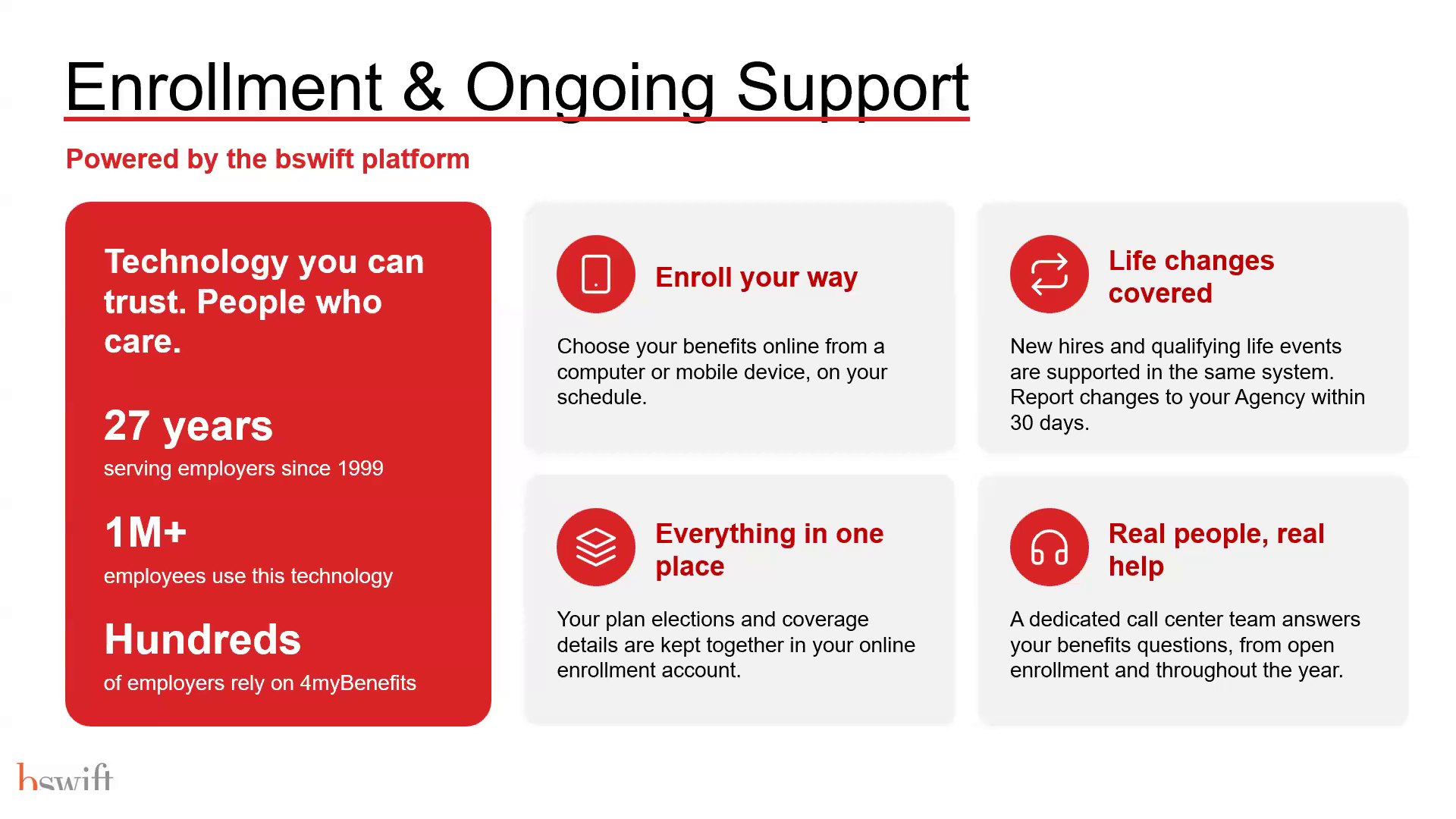
Enrollment is online through 4myBenefits, powered by the bswift platform, from a computer or phone.
Your agency gets one monthly bill for everyone enrolled under it, through a third-party billing administrator. You pay that bill. If team members pay part of their premium, you collect their share through your own payroll, just as you would with any employer plan.
The administrator collects from every agency and sends a single payment to Blue Cross each month. Payment setup details will come with enrollment.
New hires and qualifying life events (marriage, a new baby, losing other coverage and so on) are handled in the same online system. Report changes to your agency within 30 days.
Whether new hires have a waiting period before coverage starts is being confirmed.
Updates are coming from two places between now and the end of open enrollment: NASFA and Agency Network. Make sure you're getting both.
Join NASFA (you need to anyway to enroll) and make sure NASFA has a personal email address for you. Questions go to membership@nasfa.com.
Agency Network has been getting the word out on this plan for months, and it's sending every update too. Enrollment reminders, deadline alerts, the free update calls with Brown & Brown, and answers to the questions that keep coming in. Three things make sure all of it reaches you:
Agency Network membership isn't required for the health plan. It's just the surest way to hear about every update.
Because emails sent to @statefarm.com addresses, and any redirected emails, are frequently blocked or never delivered. This is a known, documented problem, not a theory.
Enrollment links go out by email. If the only address on file for you is your State Farm email, there's a real chance you won't receive your enrollment link or deadline reminders. That's how someone misses open enrollment entirely.
Make sure NASFA has a personal email for you. If you're not sure, email membership@nasfa.com.
Same goes for Agency Network: put your personal email in your Agency Network member profile so its updates reach you too.
This FAQ is updated as answers are confirmed, including the hundreds of questions asked during the October 20 presentation. NASFA and Brown & Brown will share it through their websites and member email. Bookmark it and check back before November 16.
Agency Network is sharing every update as well, through agcynetwork.com, its member emails and the Agency Network Facebook group, and it plans more free update calls before enrollment closes.
Email membership@nasfa.com or call NASFA at 800.789.8609, Monday through Friday, 8 am – 5 pm Central.
A dedicated phone line just for State Farm agents. You'll be able to call with your questions and get them answered directly by the Brown & Brown enrollment team, including the ones specific to your family, your prescriptions or your agency. We don't have the number yet. It will be posted right here the moment we do.
Each open item gets answered here the moment we have it in writing. If your decision depends on one of them, email membership@nasfa.com and we'll flag you personally when it lands. A dedicated phone line for agents, answered by the Brown & Brown enrollment team, is also coming soon.
The plan is approved, priced, and locked for 2027. All that's left is the two-week window, November 16 through 27. Join NASFA now so you're ready the day it opens.
Join NASFA Open enrollment November 16–27We've been working alongside NASFA on this plan for months now. Getting the word out, pushing the census, hosting the update calls with Brown & Brown, and answering questions in the chat for as long as they kept coming.
If this plan ends up helping your agency, we'd be grateful if you'd consider joining Agency Network too. It's 20 bucks a month and your first month is free. A couple of the vendor discounts on the site pretty much pay for it, and the calls stay free either way.
To be clear, Agency Network membership is not required for the health plan. NASFA is the only membership you need to enroll.
The Agency Network Guys